
Your iPhone calls connect, but nobody can hear you. Voice memos stay greyed out. Speakerphone will not light up. The phone may even freeze for a few seconds when you try to open audio functions. That is not a random software glitch. In many cases, it points to a logic board fault known as Audio IC failure.
This is where standard phone repair shops usually stop. Screen swaps and battery jobs are one thing. Board-level faults are different. They need proper diagnosis, micro-soldering skill, and a repairer who understands how iPhone audio circuits fail in the real world.
What is iPhone audio IC repair?
iPhone audio IC repair is a motherboard-level repair that targets the audio integrated circuit and the damaged connections around it. The issue is most often linked to separation or cracking at solder joints on the logic board, rather than a simple part that can be unplugged and replaced in minutes.
On affected devices, the Audio IC chip can lose reliable connection to the board. When that happens, the phone struggles to handle microphone input, call audio, voice recording, and speaker-related functions. Some handsets show one symptom. Others show several at once.
This is not the same as replacing a loudspeaker, earpiece, charging port flex, or microphone module. Those parts can fail too, and a good technician should rule them out first. Audio IC repair is for the cases where the fault sits deeper on the board.
Common signs of Audio IC failure
The most common complaint is simple – calls are a mess. The other person cannot hear you, or the speakerphone button is greyed out. That alone does not confirm an Audio IC problem, but it is a strong clue.
Other signs include voice memos refusing to record, videos capturing no sound, Siri not hearing commands, long delays when opening phone or audio apps, and intermittent audio that works only when the phone is flexed or pressed in certain areas. Some users also notice the device becoming stuck on the Apple logo or acting unstable after drops or bending stress.
Why these symptoms can be misleading
The tricky part is that bad microphones, water damage, dock flex issues, and software faults can mimic some of the same behaviour. That is why proper testing matters. Replacing random parts first often wastes time and money.
A professional diagnosis should check whether the fault comes from external components or from the board itself. If the root cause is on the logic board, no amount of software resets or accessory swaps will fix it.
Why Audio IC faults happen
On certain iPhone models, repeated flexing of the board is a known cause. Phones live in pockets, get sat on in cars, dropped on concrete, and twisted inside tight cases. Over time, that mechanical stress can weaken the board or crack solder connections under the chip.
Previous repair damage can also play a part. Poor-quality screen repairs, heavy prying, and rushed handling can place pressure on already vulnerable board areas. Water exposure adds another layer of risk. Corrosion around audio lines can create similar symptoms or compound an existing weakness.
It depends on the model and the history
Some iPhones are more commonly associated with this failure than others, but model alone is not enough to diagnose it. A device with no visible damage may still have board separation. Another may look rough but only need a charging port or microphone assembly.
That is why board-level diagnosis has to come before pricing promises. A serious repairer will tell you what has actually failed, not guess from a symptom list.
How iPhone audio IC repair is done
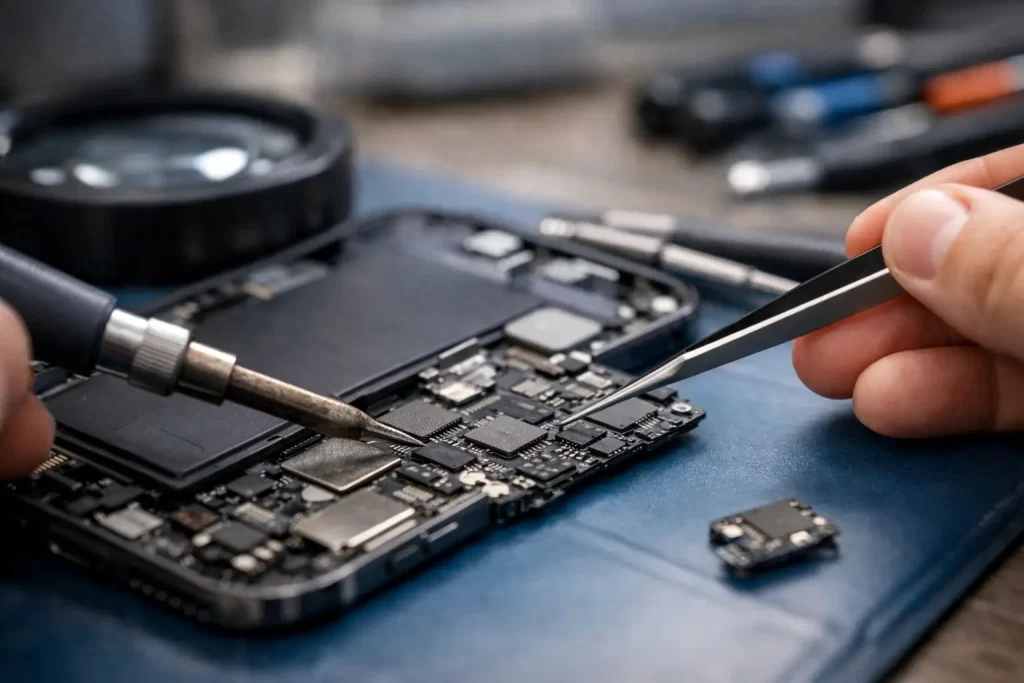
This is precision work. The phone is opened, the board is removed, and the affected area is inspected and tested under magnification. Once the fault is confirmed, the technician uses micro-soldering equipment to rework or replace the Audio IC and restore the damaged circuit path.
In many cases, the repair is not just about swapping the chip. Reinforcing a broken pad or rebuilding a damaged trace may be necessary. If the underlying board damage is ignored, the problem can come back.
Why this is not a DIY repair
Audio IC work happens on densely packed logic boards with heat-sensitive components all around them. Using the wrong temperature, poor shielding, or shaky technique can lift pads, warp the board, or kill the phone completely.
That makes this one of the clearest examples of a repair that should stay off the kitchen table. If the data on the phone matters, the risk is even higher.
Is Audio IC repair worth it?
Often, yes. If the phone is otherwise in good condition and the repair cost is reasonable compared with replacement, a board-level fix can be the smart move. That is especially true if the device holds important photos, work apps, notes, or messages you want to keep accessible.
It is less straightforward on very old devices with poor battery health, cracked screens, or multiple existing faults. If a phone needs an Audio IC repair, a battery, and a screen at the same time, the maths may shift. The right answer depends on the model, the condition, and how urgently you need a reliable phone back in service.
Data matters as much as the handset
For many customers, the phone itself is not the whole story. What matters is keeping access to banking apps, business contacts, two-factor authentication, school files, and irreplaceable media. A successful board-level repair may restore all of that without the disruption of starting over on a new device.
How long does iPhone audio IC repair take?
Turnaround depends on parts availability, workshop load, and the extent of board damage. Straightforward cases can move quickly. More complex repairs involving corrosion, trace repair, or prior failed work take longer.
If you rely on your phone for work, this is the question to ask first. A good repair shop should be upfront about timing, not vague. At iSmashed, advanced logic board and micro-soldering jobs are assessed properly so you know whether the repair is viable and what the realistic timeframe looks like.
What affects the cost?
There is no honest flat answer without diagnosis. The cost depends on the model, the board condition, whether the chip itself needs replacement, and whether surrounding damage is present. Water-damaged boards, for example, can require more than one fault to be addressed.
Cheaper quotes are not always better value here. If the technician only reflows a chip without fixing the actual weak point, the symptom may disappear briefly and then return. Proper board work costs more than trial-and-error repairs because it requires specialist skill and equipment.
Ask about warranty and repair method
When comparing quotes, ask what is actually being done and whether the repair carries a warranty. That tells you a lot. Shops that stand behind their work are usually more disciplined in diagnosis and execution.
When to stop using the phone and get it checked
If your speakerphone has gone grey, voice memos will not record, or call audio keeps dropping out, do not keep forcing restarts and hoping for the best. Continued flexing, charging, or rough handling can worsen an already unstable board fault.
Back up the phone if you still can. Then book a proper assessment. The sooner a board issue is diagnosed, the better the chance of a clean repair before other faults appear.
Choosing the right repairer for Audio IC faults
This is one of those jobs where board-level capability is not optional. You want a repairer who handles micro-soldering, logic board diagnostics, and named faults like boot loop, backlight failure, pry damage, and IC-related issues on a regular basis.
Speed matters, but not at the cost of accuracy. So does convenience. For busy Darwin locals, students, shift workers, and small business owners, the best repair experience is simple – clear diagnosis, fair pricing, fast turnaround where possible, and a proper warranty so the risk stays low.
If your iPhone has started acting strangely around calls, recording, or speaker functions, do not assume it is just old age. Audio IC faults are real, repairable, and very often worth fixing when the job is done properly. The right repair can save the handset, the data, and a lot of frustration – which is exactly what a good local repair shop should do.