
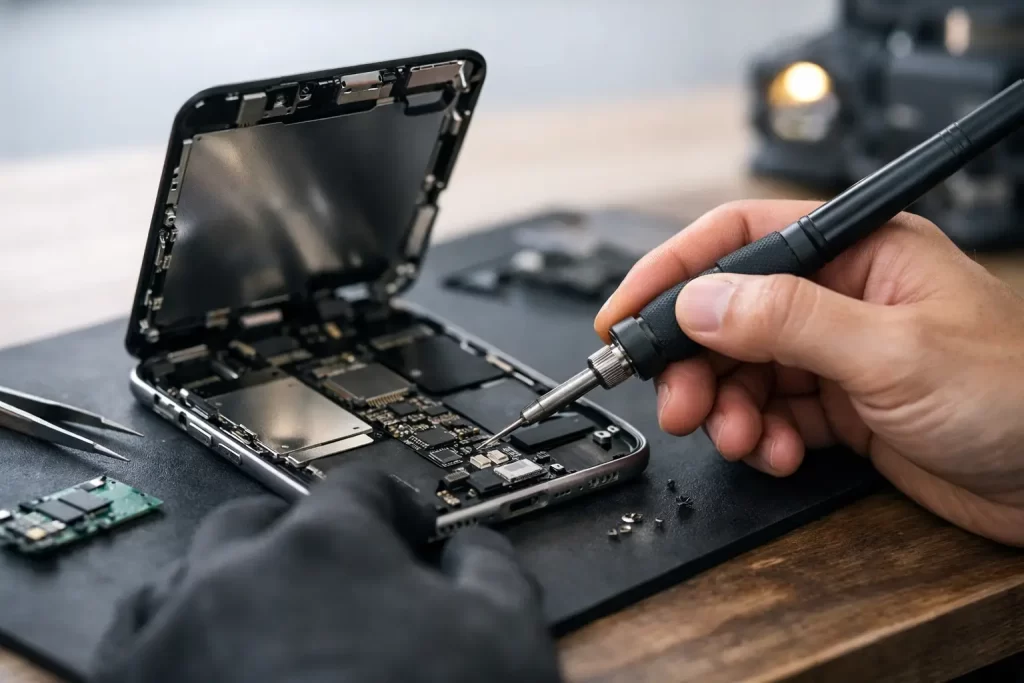
When your iPhone screen looks fine but taps stop registering, type on their own, or lag badly, the problem may not be the glass at all. That is often where iphone touch ic repair comes in. It is a board-level repair, not a standard screen swap, and getting that diagnosis right saves time, money, and a lot of frustration.
For many people, this fault shows up after a drop. The phone still powers on. The display still lights up. You might even unlock it after a few tries. Then the touch starts cutting in and out, scrolling goes wild, or parts of the screen stop responding completely. It feels like a screen issue, but sometimes the actual fault sits deeper on the logic board.
What is iphone touch ic repair?
Touch IC repair is the process of fixing the chips and surrounding circuitry on the iPhone logic board that control touch input. On certain models, especially older devices known for touch disease, impact damage or board flex can break the solder joints under the touch integrated circuits. In other cases, previous poor-quality repairs, heavy drops, or frame bending can damage the board traces around them.
This is not the same as replacing a cracked screen. A screen replacement fixes the display assembly. An iPhone touch IC repair targets the motherboard itself using micro-soldering tools, board diagnostics, and precise component-level work. That is why it usually needs a technician with real logic board experience.
Signs the fault is more than just the screen
The tricky part is that touch faults can overlap. A damaged screen can cause dead zones or ghost touch. So can a faulty digitiser connector. So can logic board damage. The difference comes from testing, not guesswork.
Common symptoms that may point to touch IC trouble include touch working intermittently, the screen becoming unresponsive after a drop, grey flickering bars near the top on some models, or the phone responding differently when pressure is applied to the frame. You might also notice that a brand-new screen does not solve the issue. That is one of the clearest signs the problem sits on the board.
If the device has been bent in a pocket, dropped multiple times, or previously repaired by someone who was rough during disassembly, board damage becomes more likely. Pry damage, torn pads, and stressed connectors can all lead to touch-related faults.
Which iPhone models get this problem?
Some models are more commonly associated with touch IC faults than others. The iPhone 6 Plus is the best-known example because of the touch disease issue, where repeated flexing can weaken the board and break the connection under the touch chips. The iPhone 6 can also suffer board-related touch faults, though usually less often.
That said, newer iPhones are not immune. Hard drops can damage the board on later models too. The symptoms may look a bit different, and the exact repair path depends on the board layout, but the core issue is the same – touch data is not getting processed properly because of failed components or damaged lines.
This is why model-specific diagnosis matters. Not every non-responsive screen needs board work, and not every board-level fault is a touch IC issue. A proper bench test helps separate a straightforward parts job from a micro-soldering repair.
Why diagnosis matters before any repair
A lot of customers come in after being told they need a screen. Sometimes that is true. Sometimes they have already paid for one and the fault is still there. That is the expensive version of trial and error.
The better approach is to test the phone first with known-good parts, inspect the board under magnification, and check for the failure patterns common to that model. If the screen, connectors, and surrounding components test fine, then touch IC repair becomes the likely next step.
Good diagnosis also picks up related issues. A hard impact strong enough to damage touch circuitry may also affect image output, charging, audio, or baseband functions. If there is frame bend or housing distortion, that should be addressed too, because the same physical stress that caused the board failure can cause it again.
How iphone touch ic repair is actually done
This is precise work. The phone is disassembled, the logic board is removed, and the affected area is inspected under microscope. The damaged chip may need to be removed, the board pads cleaned, broken traces repaired, and the IC reballed or replaced. In some cases, reinforcement work is also carried out depending on the model and fault pattern.
Heat control matters. So does experience. Too much heat can warp the board or damage nearby components. Too little and the solder work will not hold. The repair also needs proper testing afterwards to confirm the touch function is stable, not just briefly restored.
That is the difference between a quick attempt and a reliable repair. Board-level work can absolutely save a phone, but only when it is done methodically.
Is it worth repairing?
Usually, it depends on the model, the condition of the device, and whether the phone holds important data. If you have an older iPhone with no sentimental or data value, replacement might make more sense. But if the phone is otherwise in good condition, or you need the data back, touch IC repair can be a very cost-effective option.
For many customers, the real value is not just the handset. It is access to photos, messages, banking apps, work accounts, and everything else tied to that device. If touch failure is stopping you from using the phone but the board can be repaired, that is often faster and cheaper than replacing the device and rebuilding everything from scratch.
A proper quote should reflect the actual board condition. If there is heavy water damage, multiple board faults, or signs of failed previous repair attempts, the job becomes more complex. That does not always mean it is not repairable. It just means the answer is not one-size-fits-all.
Choosing the right repairer for board-level faults
This is where many people get caught out. Not every phone repair shop handles micro-soldering in-house. Some only do parts replacement. Others take in logic board jobs and send them elsewhere, which can add delay and reduce clarity around the process.
If you are dealing with a likely touch IC fault, ask direct questions. Do they perform board-level repair? Do they handle touch IC issues specifically? Can they diagnose whether the fault is screen-related or logic board-related before quoting for unnecessary parts? Is the work warranty-backed?
You want a shop that treats this as a technical diagnosis problem, not just a parts-selling opportunity. At iSmashed, that board-level capability is part of the service offering, alongside everyday repairs like screens, batteries and charge ports. That matters when the fault is deeper than the surface.
Turnaround, cost and what affects both
Touch IC repair is more involved than a screen replacement, so timing depends on the model and board condition. Some jobs are straightforward. Others reveal additional issues once the board is under microscope. That is why honest turnaround estimates matter.
Cost is shaped by labour, component availability, board damage severity, and whether there has been previous unsuccessful work. A clean, single-fault repair is usually more economical than a board that has missing pads, corrosion, or lifted traces from a bad earlier attempt.
The cheapest quote is not always the cheapest outcome. If poor workmanship damages the board further, the final repair can become harder, more expensive, or impossible. For high-skill work like this, value sits in accurate diagnosis, proper micro-soldering, and a repair that lasts.
What to do if you suspect a touch IC issue
Stop forcing the phone. Repeated hard pressing on the screen will not fix a board fault. If the device is bent, avoid further flex. If it has suffered water exposure as well as impact, do not keep charging it while hoping the problem clears up.
Back up the phone if touch still works intermittently and you can access it safely. If not, get it assessed before more damage develops. The earlier a board fault is inspected, the better the chance of a clean repair.
A non-responsive iPhone does not automatically mean the device is finished. Sometimes the fix is a screen. Sometimes it is a connector. Sometimes it needs real motherboard work. The key is getting the right answer early, so you are not paying twice or wasting days without your phone.
If your iPhone still powers on but touch has become unreliable, that is usually your cue to act quickly. The right repair can bring it back without replacing the whole device, and that is often the fastest path back to normal.