
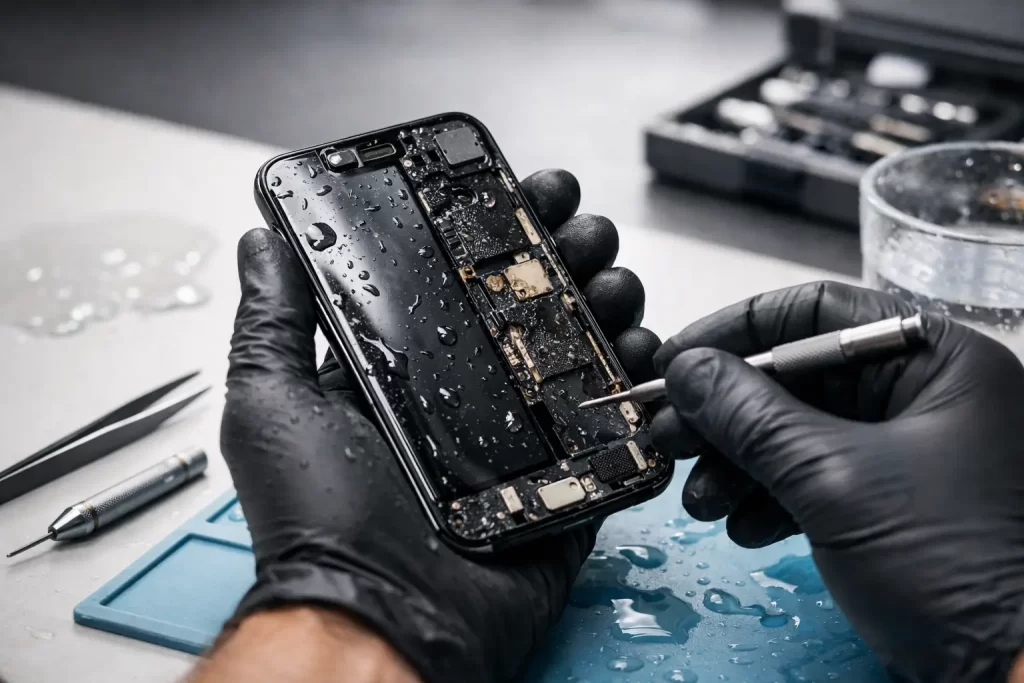
Your iPhone falls into a pool at Leanyer, gets drenched in a sudden storm on Mitchell Street, or cops a drink spill during a late shift. You dry the screen, hope for the best, and a few hours later it starts restarting, charging poorly, losing sound, or refusing to turn on at all. That is how water damage usually goes – not always instant death, but progressive failure.
If you need iphone water damage repair darwin, speed matters. Not because every wet phone can be saved, but because corrosion starts early and keeps spreading. The sooner the device is assessed properly, the better the chance of restoring the phone itself, the data on it, or both.
What water damage actually does to an iPhone
Water damage is rarely just “the phone got wet”. On modern iPhones, liquid can creep into connectors, under shielding, around battery lines and into the logic board. Once moisture mixes with current, the real problem begins. Corrosion forms on tiny components, solder joints weaken, and important circuits can start failing in stages.
That is why one iPhone may still power on after a splash, while another looks fine at first and then develops faults the next day. Face ID might stop working. Charging may become intermittent. The screen can flicker, the microphone may cut out, or the device can enter a boot loop. In more severe cases, the phone goes fully dead.
This is also why rice is not a repair. It does not remove corrosion, it does not clean board contamination, and it certainly does not fix a shorted component. At best, it wastes time. At worst, it gives the damage more time to spread.
iPhone water damage repair Darwin: what to do first
The first few steps matter more than most people realise. If your iPhone has been exposed to liquid, switch it off if it is still on. Do not keep checking whether it works. Do not put it on charge. Do not connect it to a power bank or laptop. Extra current through a wet board can turn a recoverable repair into a board-level failure.
Dry the outside with a clean cloth, remove the case and SIM tray if you can, and leave the phone alone until it can be inspected. If the phone is already off, keep it off. If it is hot, smells unusual, or the screen is glitching badly, that is a stronger sign of internal shorting.
A proper repair shop will assess more than the visible symptoms. They will inspect for liquid ingress, test charging behaviour, open the device, clean contamination, and check whether the fault is limited to replaceable parts or has reached the logic board. That distinction affects both cost and turnaround.
Why some water-damaged iPhones are simple repairs and others are not
There is no honest fixed answer for every wet phone. It depends on where the liquid went, how long it stayed there, whether the phone was charged afterwards, and which circuits were hit.
Some jobs are relatively straightforward. If liquid has mainly damaged the screen, battery, charge port or earpiece assembly, the repair may be completed quickly once the internals are cleaned and tested. Other jobs need micro-soldering because the fault sits on the board itself. That can include shorted lines, corroded pads, damaged filters, or failed ICs triggered by liquid exposure.
This is where many standard repair counters stop. They can replace modules, but they cannot always handle motherboard-level faults. For customers in Darwin who rely on their phone for work, banking, travel and day-to-day contact, that technical gap matters. The right repairer should be able to tell the difference between a parts issue and a board issue without wasting days on guesswork.
Common faults after liquid exposure
Water-damaged iPhones do not all fail the same way. A phone that still powers on can be more misleading than a dead one, because the internal damage may be hidden until a particular circuit starts dropping out.
Common faults include no power, random restarts, battery drain, no charge, touch issues, distorted display, no backlight, muffled audio, microphone failure, speaker crackle, camera errors and network problems. In more advanced cases, the phone may boot loop, fail to detect storage correctly, or show signs of board corrosion around key power-management areas.
There are also cases where the main goal is not full phone restoration but data recovery. If the handset is too far gone for economical repair, a board-level technician may still be able to stabilise it long enough to access photos, notes, contacts and business files. For plenty of customers, that is the part that matters most.
What a proper repair process should look like
A serious water-damage repair is not just opening the phone and swapping whatever looks affected. The process should start with diagnosis. That means identifying whether the battery has been compromised, whether there is active shorting, and whether any connectors, flexes or board sections show corrosion.
From there, the device is disassembled and cleaned properly. Contaminated areas need to be treated, not ignored. If the issue is isolated to damaged parts, those can be replaced and the phone retested. If there is board damage, micro-soldering and logic board repair may be required to restore function.
This staged approach matters because it avoids false promises. Some phones can be turned around fast. Others need deeper board work. A reliable local shop should be upfront about that, explain the likely path, and tell you whether the repair is aimed at full recovery, partial function, or data extraction.
Fast turnaround matters in Darwin
For busy locals, students, tradies, hospitality staff and travellers in the CBD, being without a phone is not a minor inconvenience. It affects maps, payment apps, work messages, two-factor logins, bookings and family contact. That is why speed is not just a nice extra. It is part of the repair itself.
A Darwin repair service should be set up for urgent jobs, not week-long manufacturer-style delays. Where the damage is limited and parts are available, same-day service can make a real difference. Where advanced repair is needed, clear communication matters just as much as the repair bench work.
Convenience counts too. If you are juggling work, school runs or shift hours, a come-to-you option or an easy CBD location saves another layer of hassle. When your phone has already failed at the worst possible time, the repair process should not create a second problem.
Choosing the right shop for iphone water damage repair Darwin
Not every repairer offering water-damage service has the same capability. Ask whether they handle micro-soldering in-house, whether they do logic board diagnostics, and whether they can attempt data recovery if the phone cannot be restored fully. If the answer is only screen, battery and port replacements, you may be dealing with a shop that can manage basic faults but not true liquid-board damage.
You should also look for practical things: fast turnaround where possible, transparent pricing, and a clear warranty on eligible repairs. A warranty does not mean every water-damaged phone carries the same guarantee – that would not be realistic – but it does show the business stands behind the work it completes.
For local customers, it also helps to choose a repairer that deals with more than simple handset jobs. A shop experienced in board-level repair across phones, tablets, laptops and consoles usually brings stronger diagnostic discipline to complicated faults. That matters when the problem is not obvious from the outside.
At iSmashed, that is exactly the point. Fast, affordable, professional repairs backed by real board-level capability, with a Darwin CBD location and a convenient mobile service option when getting to a shop is one more thing you do not need.
The biggest mistake? Waiting too long
A lot of people put a wet iPhone aside and hope it dries out. Sometimes they get a day or two of normal use before the real faults start. By then, corrosion has had extra time to work through connectors and board layers, and the phone may be in worse shape than it was on day one.
If your iPhone has been exposed to water, the best move is simple: stop using it and get it assessed quickly. Some phones are straightforward saves. Some need component-level repair. Some are mainly data-recovery jobs. The key is finding out early, while there are still options.
When your phone carries your messages, photos, work apps and daily routine, “wait and see” is usually the expensive choice.