
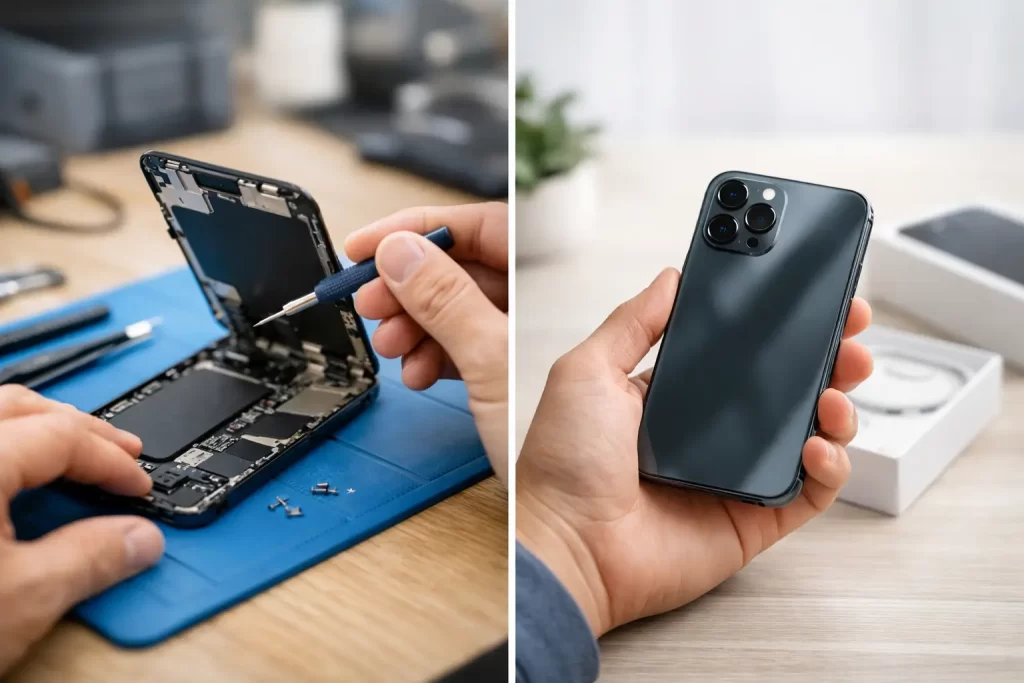
Your iPhone stops charging on a work day, the screen is shattered before school drop-off, or it lands in water on a Darwin weekend. In that moment, iPhone repair vs replacement is not a theory problem. It is a time, cost, and data problem. Most people do not need a new phone as quickly as they think. They need a clear answer on what can be fixed, what is worth fixing, and how fast they can get back up and running.
For a lot of faults, repair is the better call. It is usually cheaper, often faster, and it lets you keep the device, setup, apps and data you already rely on. But there are cases where replacement makes more sense, especially when the handset is heavily damaged, already ageing, or has multiple faults stacking up at once. The right choice depends on what failed, how old the iPhone is, and what you need from it over the next 12 to 24 months.
iPhone repair vs replacement: start with the fault
The first question is simple. What exactly is wrong with the phone?
If the issue is limited to one common part, repair is often straightforward. Cracked screens, worn batteries, faulty charge ports, damaged back glass and some camera issues are typical examples. These faults are usually far cheaper than buying another iPhone, and in many cases they can be handled the same day. If the phone was working well before the fault, replacing one failed part can give it plenty of life again.
It changes when the problem is not isolated. A phone with water damage, charging issues, battery drain, Face ID failure and board-level faults all at once is a different conversation. At that point, the cost of restoring it can start to approach the value of the device. That does not always mean replacement is the better move, especially if there is important data on the phone, but it does mean the decision needs a proper assessment rather than a guess.
When repair usually makes sense
Repair is often the smart option when the iPhone is otherwise in good condition and the damage is limited. A cracked display on a two-year-old device is annoying, but it is not a reason to write off the whole handset. The same goes for battery wear. If battery health has dropped and the phone needs charging by lunchtime, a battery replacement is normally far more cost-effective than buying another device.
Charge port repairs are another good example. Many people assume a phone that will not charge is dying. Sometimes it is just debris packed into the port. Sometimes the port itself is damaged. Sometimes the issue sits deeper on the board. The point is that replacement should not be the first assumption. A proper diagnosis matters.
Back glass damage also looks worse than it often is. It affects usability, resale value and safety, but it does not always mean the phone is beyond repair. If the rest of the device is healthy, fixing the glass can be the cheaper and cleaner option.
When replacement is more realistic
Replacement starts to make more sense when the iPhone has serious compound damage. Think major liquid exposure, board corrosion, repeated restarts, no power, failed previous repairs, bent frame damage, or multiple parts failing together. If the phone is already several generations old, repair costs can become hard to justify against the remaining value of the handset.
Another factor is future reliability. You might be able to repair one major fault, but if the battery is poor, the screen is tired and the charging system is intermittent, you are not deciding on one repair. You are deciding whether the device is worth continued investment.
That matters for small business users and busy professionals in particular. If your phone is your hotspot, your EFTPOS backup, your booking system, your maps and your camera, downtime costs you more than the repair bill. A newer replacement may be the more practical choice if the current phone is becoming unreliable overall.
Cost matters, but so does timing
People often compare repair and replacement on price alone. That is too narrow.
A replacement phone costs more than the sticker price if you add setup time, account logins, app recovery, banking verification, eSIM transfer, accessory compatibility and the simple hassle of moving your day across to another device. Even when you buy a second-hand handset, there is still uncertainty around battery health, parts history and how much life is actually left in it.
Repair is usually easier on both budget and time if the fault is clear. A screen or battery replacement can often get you moving again quickly without the admin headache. That matters in Darwin, where people often want the problem sorted fast, not shipped away for a week while life piles up around it.
This is where turnaround matters just as much as price. A repair completed in under an hour can be more valuable than a cheaper option that leaves you without your phone for days.
Data changes the equation
The biggest reason people choose repair over replacement is not the handset. It is the data.
Photos, notes, business contacts, authenticator apps, WhatsApp history, work files and family messages are often worth more than the phone itself. If the iPhone is not powering on, replacing it does nothing for the information trapped inside. In those cases, repair is sometimes the path to recovery rather than just the path to using the phone again.
This is especially true after water damage or logic board faults. A standard swap to another device may solve the hardware problem, but it does not recover what was not backed up. Board-level repair, micro-soldering and proper diagnostics can make the difference between losing everything and getting critical data back.
That is why iPhone repair vs replacement should never be reduced to a simple retail decision. If your data matters, the device may still be worth repairing even when replacement looks cheaper on paper.
Age of the iPhone still matters
There is no universal cut-off point, but age matters because it affects performance, software support and parts value.
If your iPhone is relatively recent and has one main issue, repair is usually the better bet. You preserve a device that still has useful life left. If the handset is older and already slow, has poor battery life, and is no longer meeting your needs, replacement may be the more sensible investment.
That said, age alone should not decide it. Some older iPhones are still perfectly adequate for calls, messaging, banking, photos and school or work basics. If the user is happy with the phone and the repair cost is reasonable, fixing it can still be the right move. Not everyone needs the latest model. They need a reliable one.
Be careful with quick assumptions
A lot of people make the replacement decision too early because the fault looks dramatic. A smashed rear panel, boot loop, no touch response or black screen does not automatically mean the phone is finished. Some of the most alarming faults are still repairable.
The opposite is also true. A phone that seems mostly fine but has hidden liquid damage or board corrosion may not be a simple repair. That is why proper diagnosis matters more than guesswork. You want to know whether the problem is isolated, whether it is likely to return, and whether the repair cost makes sense against the actual condition of the device.
A repairer with board-level capability can also give you a more accurate answer. Shops that only handle basic part swaps may jump straight to replacement when the fault sits deeper. A technician who can diagnose charge circuits, audio IC faults, backlight failure or pry damage gives you a better chance of making the right call.
The practical way to decide
If you are weighing up repair or replacement, keep it simple. Look at four things: the type of fault, the age of the phone, the value of your data, and how quickly you need a working device.
If the fault is common and isolated, repair is usually the smarter option. If the device has multiple serious issues, is ageing badly, and would need heavy spend to stay reliable, replacement may be the better long-term move. If your data is critical, repair may be worth attempting even when the phone itself is not.
For Darwin customers, speed and convenience often tip the balance. A fast, local repair with clear pricing and a warranty can be the difference between a small interruption and a full week of disruption. That is why many people choose a proper assessment first. At iSmashed, that means looking at the real fault, not just the obvious symptom, so you can decide with confidence instead of guessing.
The best choice is the one that gets you back to normal quickly, without overspending on a problem that could have been fixed properly the first time.