
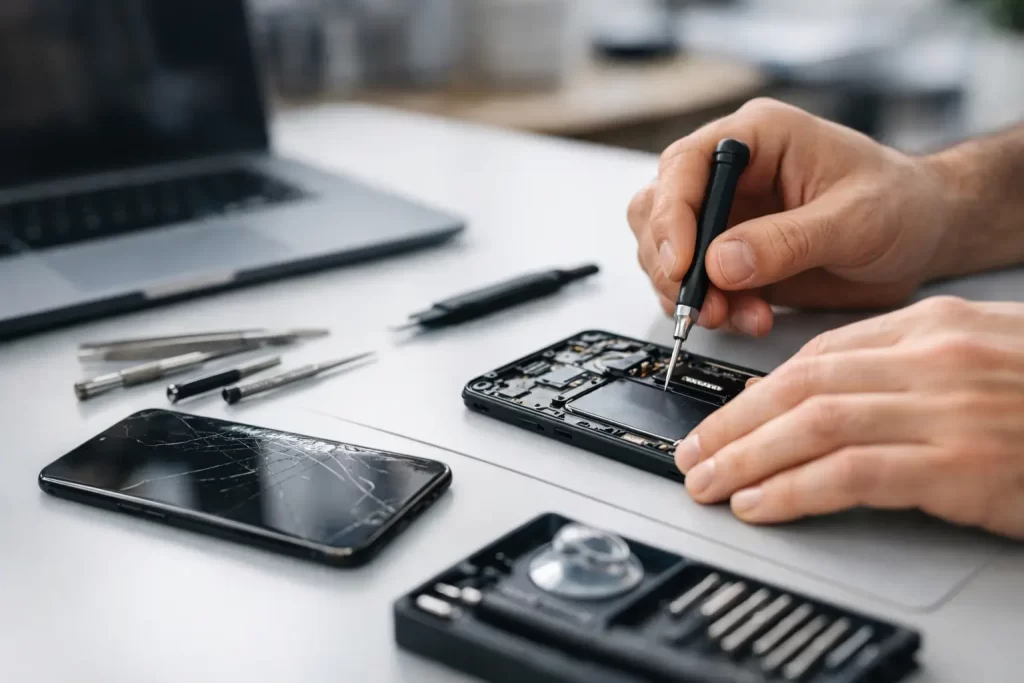
When your phone stops charging on a workday, the debate around right to repair phones stops sounding political and starts sounding personal. You do not care about slogans in that moment. You care about getting your device working again, keeping your data intact, and not waiting weeks for a basic fix.
That is exactly why this issue matters. For most people in Darwin, a phone is not a luxury item. It is banking, messages, shift rosters, school apps, maps, photos, two-factor authentication and often the main way you run day-to-day life. If repair options are restricted, the real cost shows up fast – more downtime, fewer choices, higher prices and more devices thrown away before their time.
What right to repair phones actually means
At its simplest, right to repair phones means owners should have a fair chance to fix the devices they have paid for. That includes access to parts, diagnostic tools, repair information and software support needed to complete common repairs properly.
In practice, this can cover straightforward jobs like screen replacement, battery replacement and charge port repair, but it also matters for more complex work such as micro-soldering, board-level fault finding and data recovery after liquid damage. A repair shop can only do its job well if the parts and information exist to support it.
This does not mean every repair should be attempted at home. Some people are comfortable replacing a battery. Others are far better off handing over a water-damaged iPhone, a boot-looping Samsung or a device with no backlight to a technician with the right tools. The point is choice. Owners should not be forced into one repair path when several good options could exist.
Why restricted repair hurts everyday users
The biggest problem is delay. If manufacturers lock down parts, tie components to software, or limit diagnostics, simple repairs can become slow and expensive. That is bad enough for a spare device. It is far worse when the phone in question is your only phone.
For a student, that can mean missing uni communications or assessment alerts. For a tradie or hospitality worker, it can mean missed calls and lost jobs. For a small business owner, it can mean no access to banking apps, invoices, customer messages or booking systems. The repair issue is not abstract. It affects income, access and time.
Cost is the second problem. When repair pathways are tightly controlled, pricing often moves one way. Up. Customers end up comparing an expensive official repair against replacing the device altogether. That can push people into buying a new phone when the original only needed a battery, charging port or board-level repair.
Then there is data. A lot of users would rather repair their own device than swap to a replacement unit, especially if the original contains family photos, work files, notes or app setups that are difficult to recreate. In some cases, keeping the original handset alive is the safest route to preserving what matters.
The repair side most people never see
Many phone faults are not as simple as a cracked screen. A handset might show no power because of liquid damage, corrosion, a failed charging circuit, damaged pads, battery communication issues or a short on the board. Another phone may charge only at a certain angle, restart randomly, lose touch function after a drop or stop producing sound because of a board fault.
This is where right to repair phones becomes more than a consumer-rights slogan. If skilled technicians cannot access workable parts or the information needed to test faults accurately, customers lose out. Good repair depends on diagnosis, not guesswork.
That matters even more with modern devices, where manufacturers increasingly pair parts to software or make component swaps harder than they need to be. Security has a role here, and no one sensible is arguing against proper safeguards. But there is a line between protecting users and making independent repair unnecessarily difficult.
Better repair access means better outcomes
When repair is supported properly, customers get more realistic options. A worn battery can be replaced before it starts swelling or forcing shutdowns. A damaged charging port can be changed before constant cable movement causes wider problems. A cracked rear glass panel can be dealt with before moisture and dust make their way inside.
It also improves turnaround. If parts are available and diagnostics are clear, many common faults can be handled quickly. That matters in a place like Darwin, where people often want the job done without shipping a device away and waiting on a vague timeline.
Affordability improves too. More access usually means more competition, and more competition tends to produce fairer pricing. Customers can compare repair quality, turnaround and warranty rather than being boxed into one expensive option.
The environmental benefit is real as well, but for most customers it is not the first priority. People usually decide to repair because it is faster, cheaper or more practical. The reduced waste is a strong extra benefit, not the only reason.
Not every phone should be repaired
This is where some honesty helps. Repair is not always the right call.
If a device has severe board damage, heavy corrosion, multiple failed components and no strong resale or replacement value, a repair can become poor value. The same applies when a phone has already had failed repair attempts, pry damage, torn flex cables or missing shields. Sometimes the labour required to stabilise the handset outweighs the benefit.
There are also cases where a budget replacement makes more sense than a major repair on an ageing phone. A technician should say that plainly. Right to repair should mean the right to a fair repair pathway, not the promise that every damaged device is worth saving at any cost.
What customers need is a clear answer. Is the phone economically repairable? What is the likely turnaround? Is the data at risk? Is the fault isolated to one part, or are there signs of wider board damage? Straight answers matter more than sales language.
What Darwin customers should look for in a repair option
If you need your phone back fast, convenience matters as much as technical skill. A repair service should be able to explain the fault in plain English, give a realistic timeframe and stand behind the work with a clear warranty.
Just as important is repair depth. Plenty of places can swap a screen. Fewer can handle charge-port replacements cleanly, recover devices after liquid exposure, diagnose boot loops, repair damaged connectors or carry out micro-soldering on logic board faults. If the first shop only offers part swaps, a recoverable device can be written off too early.
For Darwin users, speed is a major factor. Long manufacturer timelines are hard to justify when your phone is central to work, travel and everyday communication. That is why local capability matters. A shop that can handle both common and advanced repairs in one place usually gives you a better shot at same-day progress, and in many cases a same-day fix.
At iSmashed, that practical side of repair is the whole point – fast turnaround, transparent pricing and real diagnostics, whether the issue is a simple battery replacement or a more serious board-level fault.
Where the right to repair phones debate is heading
The pressure for change is not going away. Consumers are more aware of repair restrictions than they used to be, and technicians are pushing for better access to parts, manuals and diagnostic support. Regulators are paying attention because repair touches competition, waste reduction and consumer rights at the same time.
The likely outcome is not a free-for-all. It will probably be a gradual shift towards better repair access, clearer obligations around parts availability and more scrutiny of software locks that block otherwise legitimate repairs. That will still leave trade-offs around safety, security and quality control. But there is a difference between sensible guardrails and unnecessary barriers.
For customers, the main issue stays simple. You bought the phone. You should have a reasonable chance to keep it working without being funnelled into a costly replacement.
And if your phone is already failing, the practical answer is the one that counts – get it assessed properly, get a straight quote, and choose the repair path that saves your time, your data and your money.