
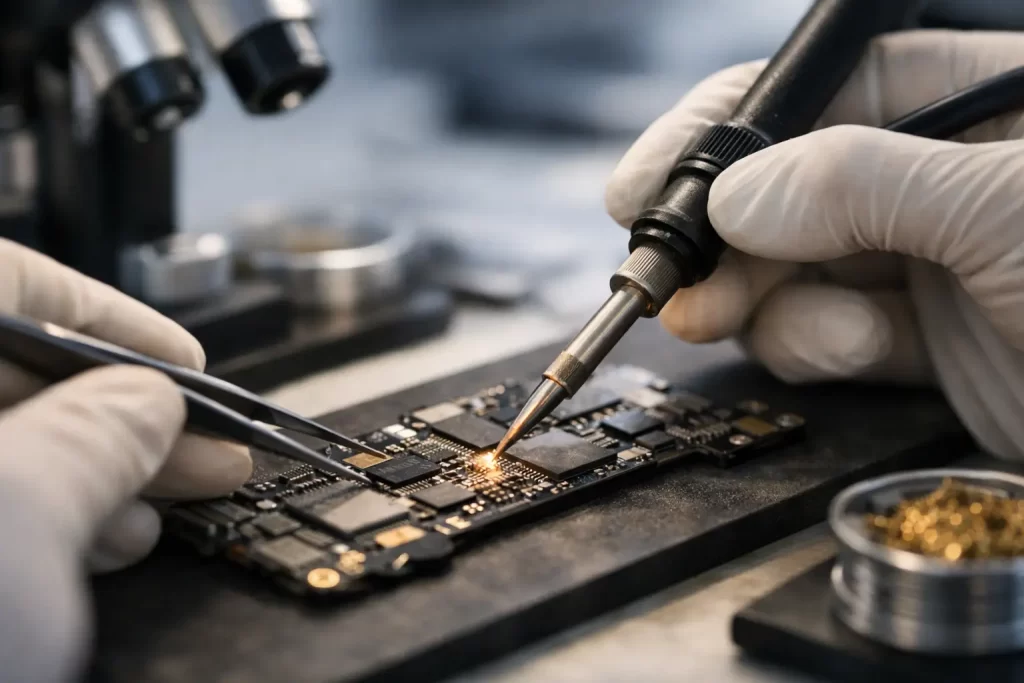
A phone that will not charge, a laptop with no backlight, or an iPad stuck in a boot loop is not always dead. In many cases, micro soldering logic board repair is what stands between a costly replacement and a working device by the end of the day. That matters when your phone is your wallet, your laptop is your office, and your tablet keeps the kids busy on a long Darwin afternoon.
Most repair shops are set up for parts swaps. Screen cracked? Replace the screen. Battery weak? Fit a new battery. That solves a lot of problems, but not all of them. When the fault sits on the board itself, replacing the obvious part will not fix it. You need proper diagnostics, steady hands, specialist tools, and someone who knows what common board failures actually look like under a microscope.
What micro soldering logic board repair actually means
Logic board repair is board-level work. Instead of swapping major parts and hoping for the best, the technician traces the fault to a specific component, line, connector, filter, chip, or damaged pad on the board. Micro soldering is the technique used to remove, replace, reflow, rebuild or reconnect those tiny parts safely.
This is the kind of work used for charging faults, short circuits, no power issues, touch disease, audio IC faults, backlight failure, Face ID related damage in some cases, and damage caused by poor previous repairs. It is also common after liquid exposure, where corrosion can spread well beyond the first visible mark.
The reason it sounds specialised is simple. It is specialised. The components are tiny, the tolerances are tight, and one wrong move can turn a repairable board into a donor board.
When a standard repair is not enough
Customers usually notice the symptom, not the cause. A phone may say it is charging but lose battery anyway. A tablet may restart every few minutes. A MacBook may power on with no image. A game console may show no signal even though the HDMI port looks fine from the outside.
These are the jobs where board diagnostics matter. A charge port replacement will not help if the charging circuit on the board is damaged. A battery replacement will not fix a power management fault. A new screen will not solve a backlight issue if the relevant components on the board have failed.
This is also where time and money can be wasted. If a shop keeps replacing parts without isolating the actual fault, the customer pays for delay and guesswork. A proper board-level approach cuts through that.
Common faults that often need board work
Some failures come up again and again. Water damage is one of the biggest. Even small exposure can corrode connectors, short lines, and damage chips over time. The device may work for a day, then fail later. That delayed failure catches people out.
Boot loop faults are another regular issue, particularly after a drop, failed update, storage fault, or previous repair. Then there are audio issues, no touch faults, Wi-Fi or network problems tied to board damage, and charging failures that are not caused by the port itself.
On laptops, common board-level faults include no power, keyboard backlight issues, liquid damage, image faults, and charging circuit failures. On consoles, HDMI and power faults often need more than a simple external inspection.
Why repair the board instead of replacing the device
The obvious reason is cost. Logic board repair is often far cheaper than replacing a high-value phone, tablet or laptop, especially when the device is otherwise in good condition. That is a practical win for families, students, and small businesses that do not want to blow the budget on a fault that can be fixed properly.
The second reason is data. If the board is the problem, replacing the whole device does not automatically get your photos, notes, business files or app data back. In many cases, board repair is the path to data recovery, particularly after liquid damage or power failure.
The third reason is convenience. Replacing a device sounds simple until you add account setup, app logins, backups, transfers, two-factor authentication, and work downtime. A successful repair avoids that disruption.
There is a trade-off, though. Not every board is worth repairing. Severe corrosion, multiple failed chips, major physical board damage, or prior botched work can push a device beyond economical repair. The honest answer is sometimes that replacement makes more sense. Good diagnostics should tell you that early.
Micro soldering logic board repair is not a DIY job
Watching a repair video can make board work look straightforward. In reality, this is one of the easiest ways to turn a recoverable device into a much more expensive problem. The heat has to be controlled. Shielding matters. Board layers can delaminate. Pads can lift. Nearby components can shift without being noticed.
Even opening the device the wrong way can create extra damage. Torn flex cables, punctured batteries, cracked coils, and pry damage around connectors are common on previously attempted repairs. We see devices that came in with one fault and arrived with three.
That is why proper tools matter. Microscope work, hot air rework stations, soldering stations, thermal diagnostics, current draw analysis, board schematics, donor components, and experience all play a part. It is not just about soldering something tiny. It is about knowing what should happen on that board, what has failed, and what can be restored safely.
What a proper repair process should look like
The first step is diagnosis, not parts ordering. A technician should test the device, inspect the board, and work through the likely failure points based on the symptom. That may involve checking voltage rails, looking for shorts, inspecting for corrosion, or assessing whether previous work has caused additional issues.
Once the fault is identified, the repair needs to be scoped realistically. Some jobs are straightforward by board-repair standards, such as a damaged connector or a known charging circuit issue. Others are more involved, especially where liquid damage has spread or multiple components have failed.
Communication matters here. Customers should know whether the issue is repairable, what the likely cost is, and whether there are risks around data or function. Clear expectations save everyone time.
Turnaround depends on the fault
Board repair is not the same as a standard screen swap, so turnaround can vary. Some faults can be handled quickly. Others need more bench time, donor parts, repeated testing, or staged cleaning after liquid exposure.
That said, speed still matters. If your phone is your work line or your laptop is needed for uni or business, waiting weeks is not realistic. A repair shop that handles both common repairs and advanced board work under one roof is usually better placed to keep things moving.
Devices that commonly need board-level repair
Phones are the most common, especially iPhones and Samsung models with charging, no power, audio, touch or data issues. Tablets follow closely, particularly after drops, bent frames, liquid exposure, or failed charging.
Laptops are a major category as well. MacBooks and Windows machines often develop board faults after liquid spills, charger issues, impact damage, or heat-related wear. Because replacement laptop boards can be expensive, repair is often the smarter option.
Consoles, drones and other electronics can also need micro soldering. The principle is the same. If the fault is on the board, someone needs to diagnose and repair the board itself rather than swapping random external parts.
Choosing the right repairer
If a shop offers micro soldering logic board repair, ask what kind of faults they handle regularly. You want more than a service name on a menu. You want real experience with boot loop repair, no power faults, charge circuit issues, audio IC work, backlight problems, pry damage and water-damaged boards.
It also helps to choose a repairer that understands urgency. For Darwin customers, convenience is not a bonus. It is part of the service. Fast turnaround, practical pricing, and a clear warranty reduce the stress when a device goes down at the worst possible time.
At iSmashed, this kind of work sits alongside the everyday fixes people already know us for. That means you are not being sent elsewhere the moment a fault becomes more technical. The same place that handles screens, batteries and charge ports can also assess the deeper board issues that standard repairs miss.
If your device is showing odd symptoms, getting hot, stuck in a loop, not charging properly, or refusing to power on after water exposure, do not write it off too early. The right repair is often smaller, faster and more affordable than replacing the whole device, and the sooner the board is assessed, the better your chances of saving both the hardware and the data.