
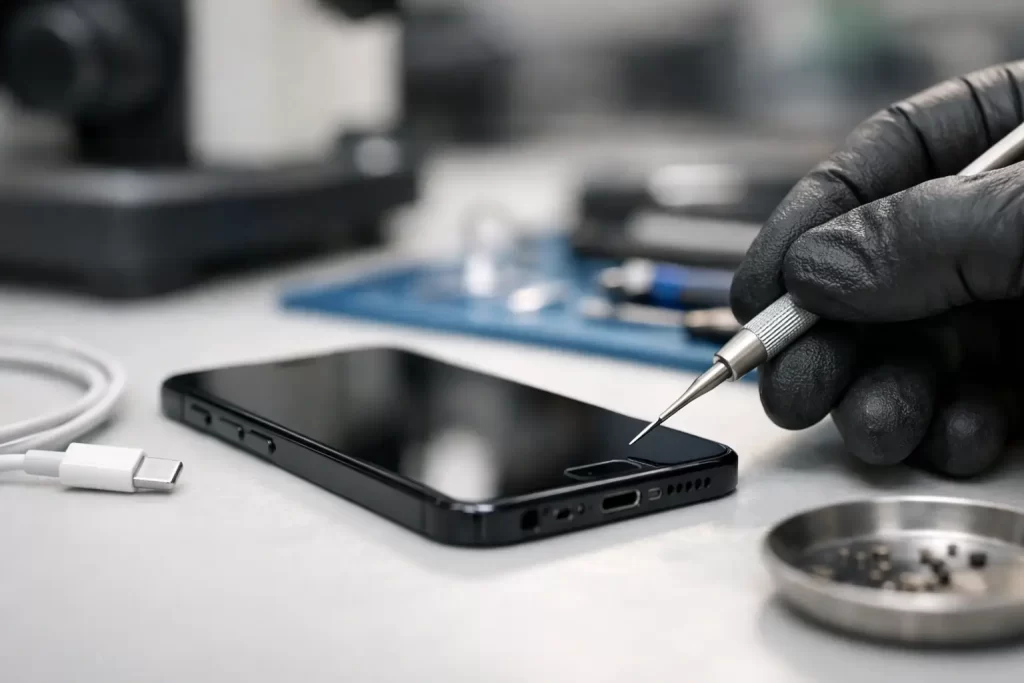
If your iPhone only charges when the cable is held at a strange angle, or it keeps connecting and disconnecting on the charger, the next question is usually the same – what is the iPhone charge port repair cost, and is it worth fixing? The short answer is that price depends on the model, the actual fault, and whether the problem stops at the port or runs deeper into the charging circuit.
For most people, this is not a repair you want to guess your way through. A charging issue can be something simple like compacted lint in the port, or something more involved such as liquid damage, board-level corrosion, torn dock flex, or charge IC failure. Those faults sit in very different price brackets, so a proper assessment matters.
What affects iPhone charge port repair cost?
The biggest factor is the iPhone model. Older devices are generally more straightforward and cheaper to repair, while newer models often take longer to open, test and reassemble. Parts pricing also varies. A dock connector assembly for one model may be readily available, while another may require a higher-cost part or more labour to fit correctly.
The second factor is whether the charge port is actually the failed part. Many customers assume the port is broken because the phone is not charging properly. Sometimes that is correct. Sometimes it is not. We regularly see phones with debris packed into the port, battery faults that mimic charge-port issues, and liquid damage that has spread beyond the connector itself. In those cases, replacing the port alone either will not solve the problem or will only solve part of it.
Labour also matters. On some iPhones, replacing the charging assembly means working around the loudspeaker, Taptic Engine, battery adhesive, display connections and other internals with very little room for error. If a repair also needs board cleaning, corrosion treatment or micro-soldering, the cost moves up because the job is no longer a standard part swap.
Typical iPhone charge port repair cost ranges
A standard charge port replacement on an iPhone often sits in a moderate repair range rather than at the very bottom end. It is usually more involved than a basic battery swap, but much cheaper than replacing the phone. For older iPhones, the repair cost is generally lower. For newer models, especially those with more compact internals and higher part costs, pricing tends to rise.
A realistic quote should reflect three things: the device model, confirmed fault, and repair method. If a shop gives a fixed figure before checking the phone at all, take that with caution. Charging faults are one of those categories where appearances can be misleading.
If the issue is simply a blocked port that needs cleaning and testing, the cost may be minimal compared with full replacement. If the dock assembly is physically damaged, worn from cable strain, or no longer making stable contact, replacing that assembly is often the right call. If liquid damage or a board fault is involved, you are no longer talking about a straightforward charge-port repair.
When the problem is not the charge port
This is where people often overpay or waste time. An iPhone that will not charge can be suffering from a battery that has dropped below safe operating voltage, a damaged charging tristar circuit, corrosion on the board, failed filters, or previous repair damage. We also see phones that charge fine wirelessly but not by cable, which can point to a port issue, though not always.
That is why proper diagnostics matter. A good technician will test with known-good cables and chargers, inspect the port, assess battery behaviour, and check whether the device is drawing power correctly. On more advanced faults, board-level testing may be needed. That extra technical depth can save you from paying for the wrong repair.
At iSmashed, that matters because not every charging fault needs the same fix. Some phones need a standard dock replacement. Others need micro-soldering or logic board repair. The difference is significant for both cost and turnaround.
Signs you may need a charge port repair
A failing port usually gives warning signs before it stops altogether. The charger may feel loose in the connector, the phone may only charge on one side of the cable, or CarPlay may keep dropping out. You might also notice very slow charging, no response when plugged in, or intermittent accessory detection.
Physical damage is another clue. If the port has been exposed to moisture, pocket debris, bent cable tips or repeated strain, wear can build up over time. In Darwin, heat, humidity and everyday dust do devices no favours either. Those conditions can speed up corrosion and contact failure, particularly if the phone has had even minor liquid exposure.
Still, symptoms overlap. A swollen or degraded battery can make charging behaviour erratic. So can poor-quality cables. Before assuming the worst, it makes sense to rule out the simple stuff first.
Is charge port repair worth it?
In many cases, yes. If the phone is otherwise in good condition and the repair is limited to the charging assembly, fixing the port is usually far more cost-effective than replacing the handset. That is especially true if you rely on the device for work, school or travel and want it back quickly without the setup hassle of moving to a new phone.
Where it becomes more of a judgement call is on older models with multiple issues. If the phone needs a charge port, a battery, and has signs of water damage, the total may start to approach the value of the device. In that situation, the sensible choice depends on how long you need the phone to last and whether preserving data matters more than resale value.
For business users and busy households, downtime often costs more than the repair itself. A same-day fix on a dependable device can be the more practical option, even if the phone is not brand new.
How to avoid paying for the wrong repair
The smartest approach is not chasing the cheapest advertised number. It is getting the right diagnosis first. A very low quote can sound appealing, but if it skips testing or uses poor-quality parts, it may lead to repeat failure or an incomplete fix.
Look for a repairer that explains what has failed, what is being replaced, and whether the phone has any related issues. Ask if the charging fault has been confirmed as a port failure rather than assumed. Also ask about warranty. A clear parts warranty gives you some protection if the replacement component fails prematurely.
Turnaround matters too. If you need your phone for work or family contact, waiting days for a vague answer is not ideal. Many standard charging repairs can be turned around quickly once the fault is confirmed and parts are available.
Why prices vary between repair shops
Not all repair pricing reflects the same service level. One shop may quote for a generic replacement part and basic fitting. Another may include full diagnostic testing, quality parts, port cleaning, post-repair charging tests and warranty cover. On paper, both are called charge port repair. In practice, they are not the same job.
There is also a skill gap. Standard mobile repair and board-level diagnostics are different disciplines. If a charging fault turns out to involve the motherboard, a shop without micro-soldering capability may only tell you the phone is beyond repair. A technician with deeper board repair experience may be able to save it – and in some cases recover data that would otherwise be lost.
That is particularly relevant after liquid damage or failed previous repairs. Those jobs need more than routine parts fitting.
Getting a clear answer on iPhone charge port repair cost
If you want an accurate price, the best move is simple: have the phone inspected before committing to the repair. That gives you a quote based on the real fault, not guesswork. For some devices, the fix is quick and affordable. For others, the charging issue is a symptom of something larger.
A proper assessment should tell you whether the port needs cleaning, replacement, or whether the device needs deeper diagnostics. It should also tell you if the repair is worthwhile compared with the age and condition of the phone.
If your iPhone is charging intermittently, not connecting by cable, or has stopped responding on charge altogether, do not leave it until the battery goes flat for good. The sooner the fault is checked, the better your chances of a straightforward repair at a lower cost. A clear diagnosis now can save you money, time and a lot of frustration later.